Thank you to all of the caregivers, Warriors, advocates, volunteers, and sponsors who helped make our first CA SCD Advocacy Day on April 20, 2026, such an impactful moment in time for Sickle Cell Disease. Your voices, leadership, and commitment to equitable care made a lasting impact at the California State Capitol.
Stay Tuned for Next Year: April 19, 2027
The success of our first CA SCD Advocacy Day means we can’t stop now. We’re working diligently to plan next year’s event and ensure California remains forever focused on SCD.
Why We Launched CA SCD Advocacy Day

Advocacy is Essential
Sickle Cell Disease (SCD) is a serious, inherited blood disorder that disproportionately affects African American, Latinx, Southeast Asian, and other communities of color. In California alone, an estimated 7,000–9,000 people live with SCD, enduring chronic pain, life-threatening complications, and frequent interactions with the healthcare system.
Despite these intensive and lifelong healthcare needs, SCD has been historically underfunded, while other rare genetic conditions—such as cystic fibrosis and hemophilia—receive significantly greater resources. These disparities have resulted in gaps in care, inconsistent treatment protocols, and limited statewide data, placing SCD patients at continued risk.
California must do better. Advocacy is essential to ensure equity, accountability, and dignity in care.
“Stand with Sickle Cell Warriors, families, and advocates as we gather at the California State Capitol to demand equitable care, resources, and accountability.”
– Dr. Carolyn Rowley, Executive Director | Cayenne Wellness Center
Advocacy Day Shirts
Join us in showing a unified message. We hope to see our community wearing these shirts as we stand in solidarity with Sickle Cell Warriors, families, and advocates calling for equitable care and resources. Get yours today.

Our Goals
Funding
Secure $15 million over three years (FY 2026–2029) to sustain and support Cayenne Wellness Center services.
Cayenne Wellness Center plays a key role in providing wraparound services that hospitals and medical centers alone cannot provide, including mental health counseling; transportation assistance; childcare and respite care; housing and utility assistance; medical, dental, and pharmacy co-pay support; patient advocacy; education and statewide awareness initiatives (such as the Sickle Cell Trait Awareness Campaign); monthly support groups; and programs that support the transition from pediatric to adult care.
This investment ensures Californians with SCD continue receiving life-saving, community-based care.
Awareness
Increase understanding of SCD among legislators, policymakers, and the public.
Advocacy
Promote equitable healthcare policies and funding for people living with SCD.
Address Gaps in Care
Improve data collection, standardize treatment protocols, and ensure consistent, high-quality care.
Elevate Lived Experiences
Elevate the voices and lived experiences of SCD warriors and families.
Accountability
Ensure California delivers equitable and culturally responsive care.
Fast Facts and Healthcare Gaps
What is Sickle Cell Disease?
Sickle-cell disease is a serious inherited blood disorder caused by a mutation in the HBB gene, which leads to abnormal, sickle-shaped red blood cells. These cells can block blood flow and cause severe health complications.
Common complications of SCD include acute pain crises, anaemia, stroke, infections, kidney failure, and pregnancy-related risks.
Source: World Health Organization
Healthcare Gaps
Only 1 out of 5 physicians feel comfortable treating SCD.
Many people with SCD do not receive recommended healthcare screenings and treatments.
Source: National Library of Medicine
Center for Disease Control
Prevalence
Affects more than 100,000 people in the United States and
8 million people worldwide.
In the U.S., 9 out of 10 people with SCD are of African ancestry
or identify as Black.
About 1 in 13 Black babies is born with sickle cell trait (one sickle cell gene).
About 1 in 365 Black babies is born with sickle cell disease
(two sickle cell genes).
Source: National Heart, Lung, and Blood Institute
Life Expectancy
People with SCD in the U.S. have an estimated life expectancy
more than 20 years shorter than average.
Source: Center for Disease Control
Our Legislative Asks & Talking Points
Click on our legislative asks (Ask #1 and Ask #2) below to expand each section for further information and the corresponding talking points.
Ask #1 | Appropriate $15 Million Over Three Years: FY 2026–2029 | Click to Expand
Appropriate $15 Million Over Three Years (FY 2026–2029) to Sustain and Expand Cayenne Wellness Center Services
We respectfully request an appropriation of $15 million over three years (FY 2026–2029) to sustain and expand community-based sickle cell disease services in California, building on the State’s prior $10 million investment in SCD education, outreach, mental health, and care coordination. These resources currently support a network of community-based organizations across the state and have helped fill critical gaps in care for individuals and families living with SCD.
Cayenne Wellness Center plays a key role in providing wraparound services that hospitals and medical centers alone cannot provide, including mental health counseling; transportation assistance; childcare and respite care; housing and utility assistance; medical, dental, and pharmacy co-pay support; patient advocacy; education and statewide awareness initiatives (such as the Sickle Cell Trait Awareness Campaign); monthly support groups; and programs that support the transition from pediatric to adult care.
This three-year investment will ensure continuity of these essential services, strengthen the statewide network of community-based providers, and allow programs to be sustained and expanded to meet ongoing and unmet needs. Continued funding is critical to maintaining access to life-saving, culturally responsive, community-based support for Californians living with sickle cell disease.
Talking Points:
- Senator Webber-Pierson previously championed our funding request, securing state support for Cayenne Wellness Center. As we enter this new funding cycle, we are seeking a new legislative champion to carry this request forward, as Dr. Akilah-Weber is unable to serve in that role due to her leadership position.
- The budget appropriations for sickle cell disease primarily fund existing hospital facilities. However, essential wraparound, life-saving services are underfunded. CWC currently fills this gap.
- Patients with sickle cell disease who have the highest Social Vulnerability Index scores—defined by factors such as socioeconomic status, transportation access, and minority status—face nearly five times greater risk of death than patients with the lowest scores (Tan et al. 2024).
- Children with SCD who live in food deserts and lack reliable transportation experience higher rates of hospitalization and acute care utilization—even when receiving evidence-based therapies (Khan et al. 2024).
- Depression rates (26%) and depressive symptoms (32%) among individuals with SCD far exceed those of the general U.S. population (9.5%) (Jenerette, Funk, and Murdaugh 2005).
- Total health care costs for adult SCD patients with depression were more than double those of SCD patients without depression (Adam et al. 2017)
- The majority of inpatient SCD care in California is financed by public programs. Approximately 70% of individuals with SCD are covered by Medi-Cal, California Children’s Services (CCS), and/or other state-run programs, either alone or in combination with Medicare (Tracking California 2025). As a result, the state has a direct fiscal interest in care models that improve outcomes and reduce avoidable hospital utilization.
- More than 80% of California counties have at least one resident living with SCD (Tracking California 2025).
Ask #2 | Statewide Adoption of Evidence-Based SCD Guidelines | Click to Expand
Require Statewide Adoption of Evidence-Based Sickle Cell Disease Guidelines and Strengthen Hospital Accountability Across California
Care for Sickle Cell Disease (SCD) in California remains inconsistent and inequitable. Many hospitals rely on internal protocols that vary widely and are often influenced by provider bias, gaps in training, or outdated practices. These inconsistencies result in preventable complications, prolonged hospitalizations, avoidable deaths, and unnecessary suffering for individuals living with SCD and their families.
California already requires standardized, evidence-based protocols for conditions such as trauma, stroke, perinatal care, and STEMI to ensure timely and high-quality treatment. Sickle Cell Disease deserves the same level of statewide consistency, accountability, and clinical rigor.
We are calling on the State of California to require all acute care hospitals to adopt and implement the National Heart, Lung, and Blood Institute (NHLBI) and American Society of Hematology (ASH) Guidelines for the management and treatment of Sickle Cell Disease across emergency, inpatient, and outpatient settings.
This statewide approach should include:
Mandatory adherence to NHLBI and ASH evidence-based clinical guidelines for SCD care
Formal partnerships with medical centers and federally qualified health centers (FQHCs) to improve care coordination and provide culturally responsive patient support.
Ongoing provider education through required CEUs/CMEs, including Sickle Cell 101, evidence-based pain management, implicit bias training, and emerging therapies
Standardized pain-crisis response protocols to reduce delays in care and unnecessary suffering
Integrated patient and family support services, including mental health services, social supports, and effective transition-of-care planning
By requiring consistent, evidence-based SCD care statewide, California can reduce disparities, improve patient outcomes, and save lives—ensuring that individuals with Sickle Cell Disease receive timely, expert, and compassionate care regardless of where they seek treatment.
Talking Points:
- Evidence-based clinical guidelines for sickle cell disease management, including pain crisis care, already exist. The National Institutes of Health’s NHLBI and the American Society of Hematology (ASH) have published nationally recognized standards; however, adoption and implementation across hospitals and medical centers remain inconsistent.
- There is significant variation in how SCD pain crises are managed across children’s hospitals in the United States (Eltorki et al. 2024).
- Patients with SCD experience longer wait times for analgesia (pain medication) in emergency departments compared to patients with other painful conditions, despite higher arrival pain scores and triage acuity levels (Lazio et al. 2010).
- Most individuals with SCD presenting to the emergency department with a vaso-occlusive crisis (VOC) are not triaged according to national guidelines, resulting in delayed pain management (Abu Haimed et al. 2025)
- California’s regionalized system for urgent heart conditions (such as ST-elevation myocardial infarction, STEMI) has been associated with improved access to appropriate hospitals and more timely treatment (Shen, Krumholz, and Hsia 2021). National studies further show that states with formal hospital destination and accountability policies achieve significantly faster, guideline-recommended care (Green et al. 2018). Together, these findings demonstrate that state-led designation and coordination frameworks can reduce variation in care and improve outcomes—an approach that could be adapted to promote more consistent and equitable care for individuals living with sickle cell disease statewide.

Save the Date
Date & Time:
April 19, 2027 | 9:00 AM – 1:00 PM PST (TBC)
Location:
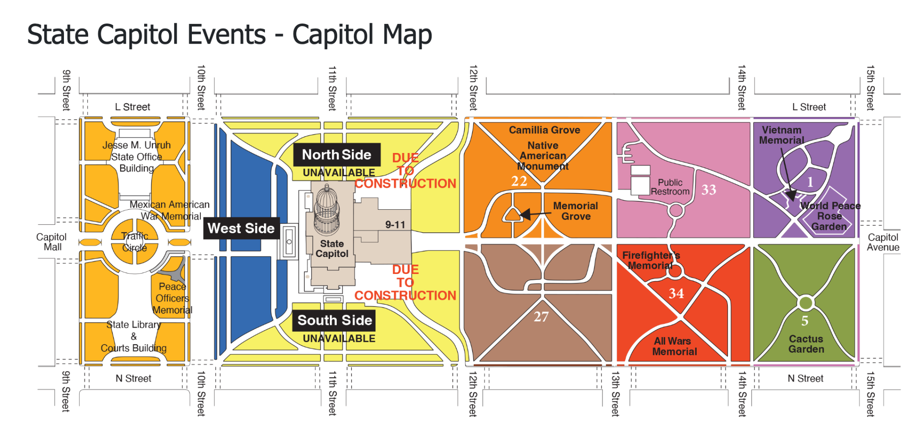
California State Capitol
1315 10th Street, Sacramento, CA 95814
Meeting Point:
West Side of the Capitol
Lodging Support:
Warriors and caregivers attending Advocacy Day can request shared lodging. Space will be limited, so we encourage you to submit your Lodging Request Form as soon as it is available.
What to Expect on Advocacy Day
Legislative visits and meetings with policymakers, conducted exclusively by trained Local Coordinator.
Community gathering with SCD warriors, caregivers, and allies.
Educational materials and advocacy toolkits.
Opportunities to share lived experiences and policy priorities.


Who Should Attend
People living with Sickle Cell Disease.
Parents, caregivers, and family members.
Community Health Workers and advocates.
Healthcare providers and researchers.
Students and future healthcare professionals.
Allies committed to health equity.
Your Voice Matters
On April 19, 2027, we will gather to demand change. By showing up together, we amplify our voices and push for policies that reflect the true needs of the SCD community.
Join us in shaping a more equitable future for people living with Sickle Cell Disease in California.

Questions?
For questions about CA SCD Advocacy Day, please contact: Jason Gamez.
To learn more about Cayenne Wellness Center, click here.